ASIC updates guidance on obligation of Australian financial services (AFS) licensees to manage conflicts of interest
On 16 December 2025, ASIC issued its updated guidance on managing conflicts of interest as reflected in Regulatory Guide 181 AFS licensing: Managing conflicts of interest (RG 181). RG 181 is intended for AFS licensees, their representatives and AFS licence applicants.
RG 181 is a significant update to ASIC’s previous conflicts-managing guidance, replacing guidance that has been largely unchanged since 2004, with ASIC acknowledging the financial services landscape and regulatory framework have markedly evolved since then. Relevantly, substantial new obligations have emerged regarding conflicts of interest and the conflicts-management duty. For example, the best-interest duty and related obligations for financial advisers, and prohibitions on certain conflicted remuneration.
ASIC aims to provide clear, current and fit‑for‑purpose guidance to help AFS licensees meet their legal obligations based on its regulatory experience, recent surveillance activities and relevant case law.
We outline ASIC’s consultation process with stakeholders and identify key areas which have been developed in RG 181. We also set out a summary of key changes to the guidance
ASIC’s consultation with industry stakeholders
Before finalising the updated RG 181, ASIC undertook extensive public consultation to test its revised guidance and ensure it remained practical. On 30 July 2025, it released Consultation Paper 385 - Proposed updated to RG 181 Licensing: Managing conflicts of interest, inviting feedback from AFS licensees, industry bodies, consumer groups and other stakeholders on the scope, clarity and anticipated regulatory and financial impacts of the proposed changes.
ASIC sought comments on a range of matters, including the breadth of the conflicts‑management obligation, the interaction between RG 181 and other legal and regulatory requirements, and the adequacy of the proposed guidance on identifying, assessing and managing conflicts of interest.
Key themes which emerged from the submissions include:
Scope of the conflicts-management obligation: submissions generally supported clarifying the scope of the conflicts management obligation and ASIC’s use of a non‑exhaustive ‘road map’ of related legal duties. However, many sought further guidance on what a proportionate, risk‑based approach entails and how ASIC will assess whether a licensee’s conflicts management arrangements are ‘adequate’. Our summary table below outlines how the updated RG 181 responds to and incorporates these matters where relevant.
Structural conflicts and vertical integration: several submissions urged ASIC to directly address structural conflicts in vertically integrated or related‑entity models. One industry body argued that the absence of structural independence between manager and trustee should be treated as a core conflict requiring strong, often structural, controls. Others sought more nuanced, case‑based examples and cautioned that related‑party or vertically integrated arrangements should not automatically be viewed as conflicted, noting they can deliver value when well governed.
Wholesale vs retail distinctions: some industry bodies criticised the draft RG 181 for not distinguishing between wholesale and retail expectations, arguing that statements like ‘mere disclosure is unlikely to be sufficient’ could be misread as universal, even though disclosure, supported by contractual terms and governance, can often suffice for sophisticated wholesale clients. While maintaining that disclosure alone will generally be inadequate, the updated RG 181 clarifies that disclosure remains a valid tool and that disclosures to wholesale clients may be less detailed than those for retail clients.
Fees, remuneration and ‘excessive/unnecessary’ characterisations: several industry bodies argued that charging fees or seeking profit is not inherently a conflict and sought clearer guidance on when fee structures become problematic. They also asked ASIC to refine examples, remove vague terms like ‘unnecessary fees,’ and avoid blanket positions on commission‑based remuneration given its prevalence in brokerage models. The updated RG 181 does not alter ASIC’s stance, confirming that entities may earn profits or returns for providing financial services, provided they deal fairly.
Key changes to guidance on conflicts of interest
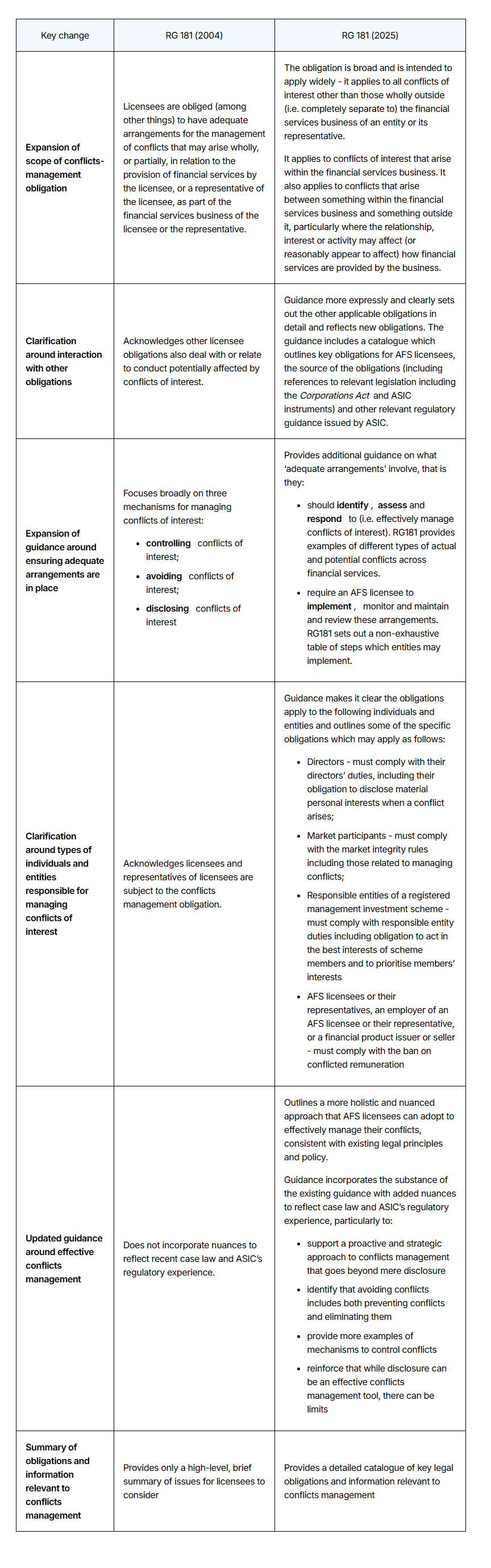
In updating RG 181, it appears ASIC has responded to some of the issues and concerns raised by industry stakeholders. The table below outlines these updates, comparing (where applicable) the new guidance with the 2004 version and summarising the major changes.
Implications for you
AFS Licensees, their representatives and AFS licence applicants should pay close attention to the updated RG 181 as it sets out ASIC’s comprehensive guidance in relation to conflicts management, particularly as conflicts of interest have been identified by ASIC as a key risk in both public and private markets. Conflicts of interest are a major driver of potential misconduct and often have detrimental outcomes for market integrity and efficiency and investor fairness.
If you’d like more clarity on these changes and how they might impact your policies and procedures around managing conflicts of interest or have any other questions, please reach out to the HW Funds team for tailored advice and support.
Contact